
arcsin(x), sin-1(x), inverse sine function.
Arcsin definition
The arcsine of x is defined as the inverse sine function of x when -1≤x≤1.
When the sine of y is equal to x:
sin y = x
Then the arcsine of x is equal to the inverse sine function of x, which is equal to y:
arcsin x = sin-1 x = y
Example
arcsin 1 = sin-1 1 = π/2 rad = 90°
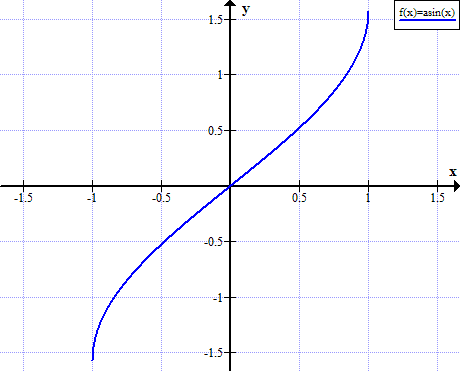
Graph of arcsin
Arcsin rules
| Rule name | Rule |
|---|---|
| Sine of arcsine | sin( arcsin x ) = x |
| Arcsine of sine | arcsin( sin x ) = x+2kπ, when k∈ℤ (k is integer) |
| Arcsin of negative argument | arcsin(-x) = - arcsin x |
| Complementary angles | arcsin x = π/2 - arccos x = 90° - arccos x |
| Arcsin sum | arcsin α + arcsin(β) = arcsin( α√(1-β2) |
+ β√(1-α2) ) |
| Arcsin difference | arcsin α - arcsin(β) = arcsin( α√(1-β2) - β√(1-α2) ) | | Cosine of arcsine | | | Tangent of arcsine | | | Derivative of arcsine | | | Indefinite integral of arcsine | |
Arcsin table
| x | arcsin(x) (rad) | arcsin(x) (°) |
| --- | --- | --- | | -1 | -π/2 | -90° | | -√3/2 | -π/3 | -60° | | -√2/2 | -π/4 | -45° | | -1/2 | -π/6 | -30° | | 0 | 0 | 0° | | 1/2 | π/6 | 30° | | √2/2 | π/4 | 45° | | √3/2 | π/3 | 60° | | 1 | π/2 | 90° |